
Gutters and downpipes are relatively straightforward building elements, yet they play an important role in protecting your property from the weather.
Their purpose is to collect rainwater from the roof and discharge it safely away from the building.
When they are not functioning as intended, considerable quantities of water can repeatedly come into contact with the external walls of your property.
Given the amount of rain we experience on the Isle of Man, it is easy to see how a relatively minor defect with the rainwater goods can develop into a more significant problem if left unaddressed.
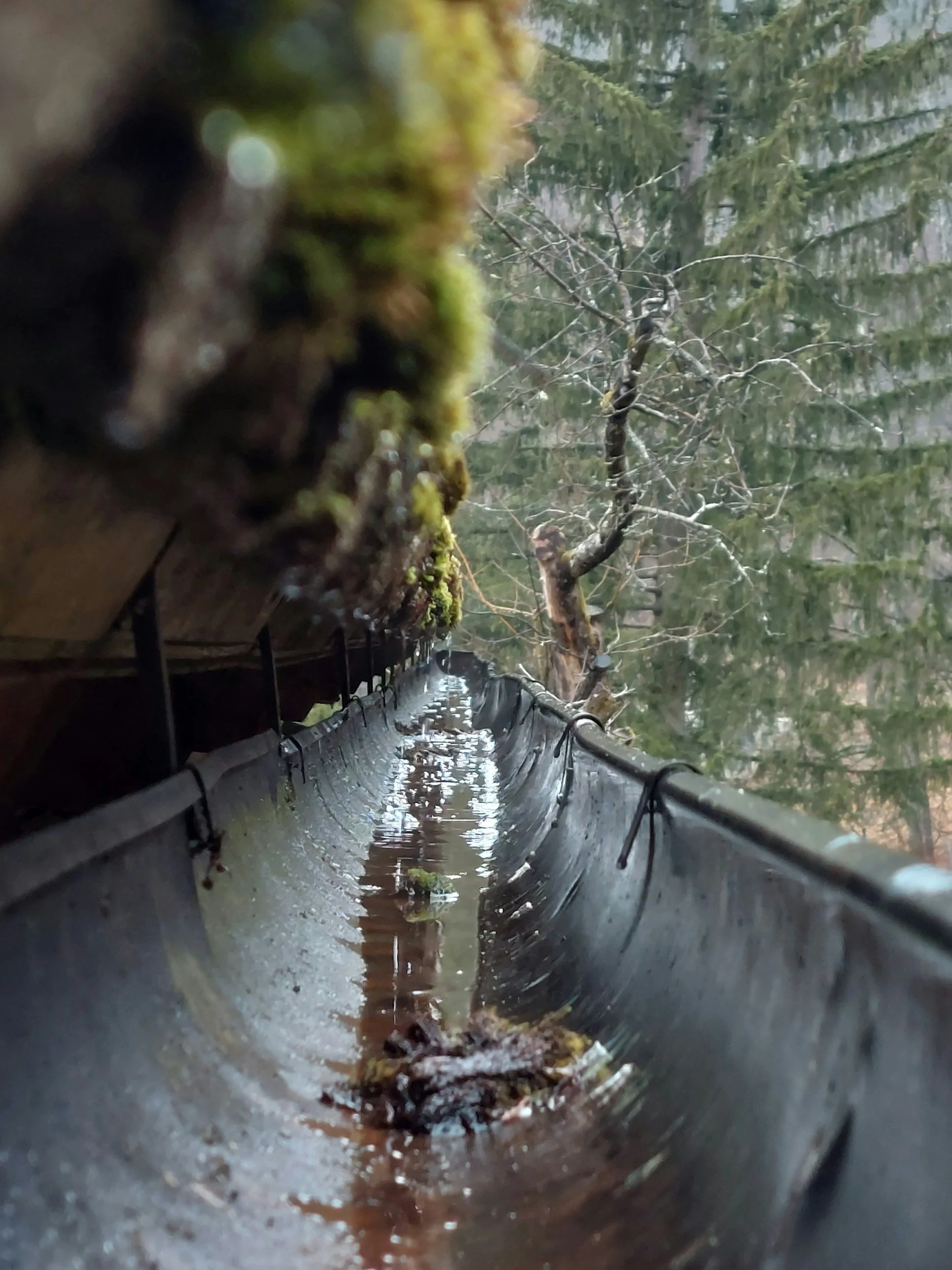
How can defective gutters cause dampness?
There are a number of reasons why gutters and downpipes may not be functioning correctly.
These include blockages caused by moss, leaves and other debris, leaking joints, damaged sections of guttering, inadequate falls and defects with the associated drainage arrangements.
In some circumstances, the rainwater goods may also have insufficient capacity to accommodate the volume of water being collected from the roof.
When water overflows or leaks from the rainwater goods, it can repeatedly saturate relatively localised areas of the building.
Over time, this may contribute to deterioration of external render and pointing, moisture penetration through the walls and damage to internal plasterwork and decorative finishes.
Where structural timbers are present within affected areas, prolonged exposure to moisture can also increase the risk of timber decay.

The importance of looking at the whole system
It is not always the gutter itself that is causing the problem.
A blocked downpipe or gully can prevent water from draining away effectively, causing it to back up or overflow elsewhere within the system.
Similarly, a downpipe which discharges water directly onto the ground alongside the building can contribute to excessive moisture at the base of the external walls.
This is why it is important to consider how rainwater is collected and discharged from the property, rather than simply addressing the area where the water is overflowing.
What about gutters you cannot see?
Some properties, particularly the older townhouses we have across the island, incorporate parapet gutters or other drainage arrangements which are largely concealed when viewed from ground level.
Valley gutters between adjoining roof slopes can also be difficult to assess.
At Manx Surveyors, we use our extendable camera poles, where safe and appropriate, to obtain a closer view of these areas during our Home Surveys.
This can help us identify visible blockages, deterioration of gutter linings, defective junctions and evidence of water ponding which may not otherwise be apparent.
Where we identify dampness internally, obtaining a better view of the external building elements above and around the affected area can be particularly useful when considering the potential source of the moisture.
Take a look next time it rains
One of the simplest ways of checking whether your rainwater goods are functioning as intended is to observe them during a period of rainfall, provided it is safe to do so.
Look for water overflowing from gutters, leaking from joints or running down the external walls. Green staining, vegetation growth and localised deterioration of external finishes can also indicate areas which are regularly exposed to excessive moisture.
We would recommend having gutters and associated drainage outlets cleared periodically, particularly where there are overhanging trees or significant accumulations of moss on the roof.
Any work requiring access to high-level areas should be undertaken by a suitably equipped and experienced contractor.
A relatively simple repair can make a considerable difference
If you have noticed dampness within your property, it is worth considering whether there are any defects with the rainwater goods before undertaking more extensive damp-proofing works.
In some circumstances, resolving a relatively straightforward external maintenance issue may be all that is required to address the source of the moisture, although the affected building fabric may take some time to dry out.
If the cause of the dampness is less apparent, or the problem continues following repairs, it may be worthwhile seeking independent professional advice.
As always, if you are unsure whether you need a surveyor or would be better served by instructing a contractor directly, feel free to get in touch with us. We are happy to discuss your concerns and point you in the right direction.